Proefschrift · Technische Universiteit EindhovenDoctoral dissertation · Eindhoven University of Technology
Professional development of secondary school teachers in facilitating feedback dialogues and student reflection
dr. Josine Görtzen
Centrale onderzoeksvraagCentral research questionWaaruit dient professionele ontwikkeling te bestaan om docenten toe te rusten voor het faciliteren van feedbackdialogen en leerlingreflectie?What should professional development encompass to enable teachers to facilitate feedback dialogues and support students’ reflective processes?
Verdedigd op vrijdag 2 oktober 2026 aan de Technische Universiteit Eindhoven.
Promotoren: prof.dr. N.M. Nieveen en dr. G.L.M. Schellings.
Defended on Friday 2 October 2026 at Eindhoven University of Technology.
Supervisors: Prof. N.M. Nieveen and Dr G.L.M. Schellings.
Dit onderzoek is gefinancierd door NWO (lerarenpromotiebeurs, 023.017.015) en Ons Middelbaar Onderwijs (OMO), en uitgevoerd aan de Eindhoven School of Education (TU/e) binnen de onderzoekschool ICO. Omslag en illustraties: Suus van den Akker.
This research was funded by the Dutch Research Council (NWO, teacher PhD grant 023.017.015) and Ons Middelbaar Onderwijs (OMO), and carried out at the Eindhoven School of Education (TU/e) within the Interuniversity Center for Educational Research (ICO). Cover and illustrations: Suus van den Akker.
SamenvattingSummary
Feedback en reflectie in samenhangFeedback and reflection as connected processes
Dit proefschrift rapporteert over onderzoek naar de professionele ontwikkeling van docenten, gericht op het voeren van feedbackgesprekken met leerlingen met als doel bij te dragen aan het verdiepen van hun reflecties. Zowel feedbackgesprekken als reflectie worden algemeen belangrijk gevonden voor het leren en de persoonlijke ontwikkeling van leerlingen, maar beide onderwerpen worden vaak los van elkaar bestudeerd. Het onderzoek in dit proefschrift beoogt deze kloof te overbruggen.
Het onderzoek is gesitueerd binnen het constructivistisch feedbackparadigma, waarin feedback wordt opgevat als een dialogisch en sociaal-constructief proces dat gericht is op het vragen, begrijpen en toepassen van feedback ter ondersteuning van leren. Binnen dit paradigma worden feedbackgesprekken en reflectie beschouwd als wederzijds versterkende processen: feedbackgesprekken verdiepen de reflectie van leerlingen, terwijl gestructureerde reflectie de invloed van feedback vergroot. Reflectie wordt in dit proefschrift opgevat als een middel voor persoonlijke ontwikkeling en groei.
In het voortgezet onderwijs, en met name binnen het vak Onderzoek en Ontwerpen (O&O, Technasium) waar leren reflecteren en persoonlijke ontwikkeling expliciete leerdoelen zijn, ervaren docenten problemen bij het vormgeven van feedback- en reflectieprocessen. Feedback blijft vaak beperkt tot eenrichtingscommunicatie, terwijl reflectietaken fragmentarisch en oppervlakkig blijven. Dit proefschrift richtte zich op het vinden van een oplossingsrichting voor deze problematiek.
Om docenten te ondersteunen is een tweejarig professionaliseringsprogramma ontworpen en geëvalueerd. In totaal bestond het onderzoek uit vijf deelstudies.
This dissertation reports on research into the question what professional development needs to encompass to enable teachers to facilitate feedback dialogues and support students’ reflection. Despite their widely recognised importance, feedback and reflection have largely been studied apart from one another. This study aimed to bridge this gap by examining how secondary school teachers can be supported in facilitating feedback dialogues and guiding students’ deep reflection through a professional development program.
The research was situated within a constructivist feedback paradigm, which conceptualises feedback as a dialogic and socially constructive process that supports meaning-making and learning. Within this paradigm, feedback dialogues and reflection are understood as mutually reinforcing processes: feedback dialogues deepen students’ reflection, while structured reflection enhances the impact of feedback. Reflection is primarily understood as a means of personal learning and growth.
In secondary education, and particularly within the Technasium context, where student reflection and personal development are explicit learning objectives, many teachers experience difficulties in implementing feedback as an interactive process. Feedback often remains a one-way transmission of information, while reflective activities are fragmented and superficial. This dissertation aims at dialogic feedback to deepen the level of students’ reflection.
Five interrelated studies were conducted, embedded within the design, enactment, and evaluation of a two-year professional development program: the Collaborative Teacher Reflection (CTR) program.
Het CTR-programmaThe CTR program
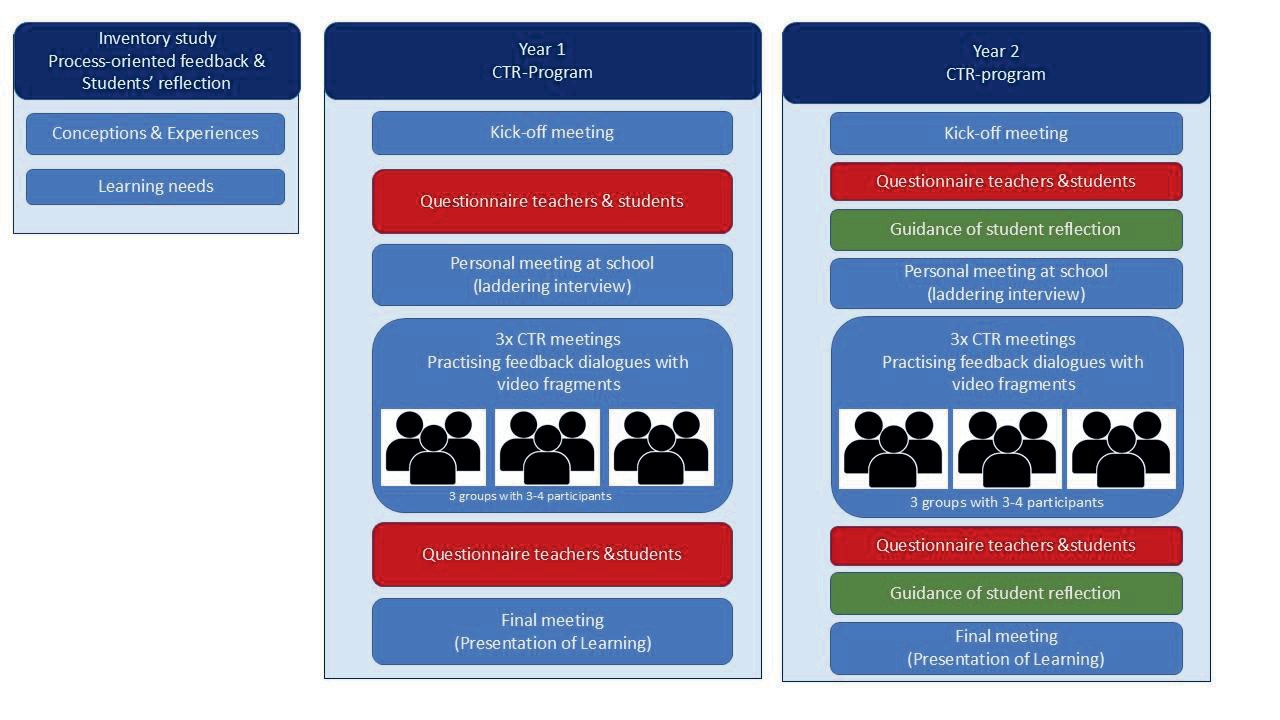
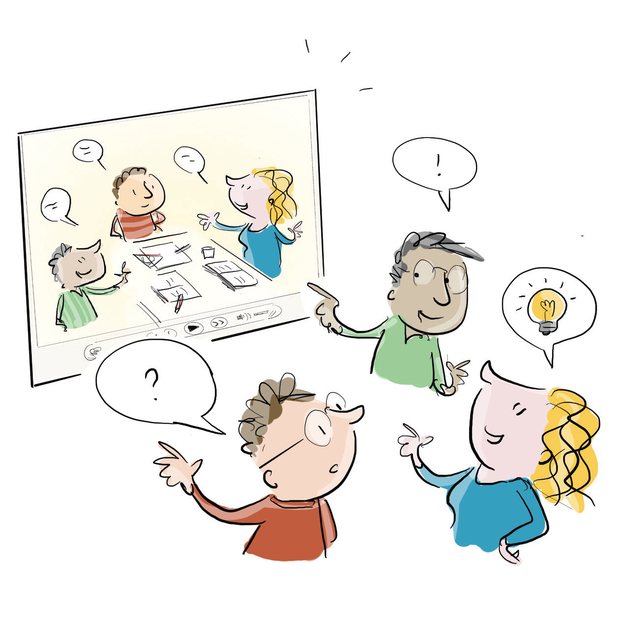
De vijf studies zijn verbonden met het tweejarige professionaliseringsprogramma Collaborative Teacher Reflection (CTR), in het Nederlands Collaboratieve Docent Reflectie (CDR). Tien O&O-docenten van negen Technasiumscholen namen deel. In het eerste jaar (2022–2023) lag de nadruk op feedbackdialogen: in kleine groepen analyseerden docenten videofragmenten van feedbackdialogen uit hun eigen lessen. In het tweede jaar (2023–2024) kwam de begeleiding van reflectietaken van leerlingen erbij.
The five studies are connected to the two-year professional development program Collaborative Teacher Reflection (CTR), known in Dutch as Collaboratieve Docent Reflectie (CDR). Ten R&D teachers from nine Technasium schools took part. The first year (2022–2023) focused on feedback dialogues, with teachers analysing video recordings of feedback dialogues from their own lessons in small groups. In the second year (2023–2024), the guidance of students’ reflection tasks was added.
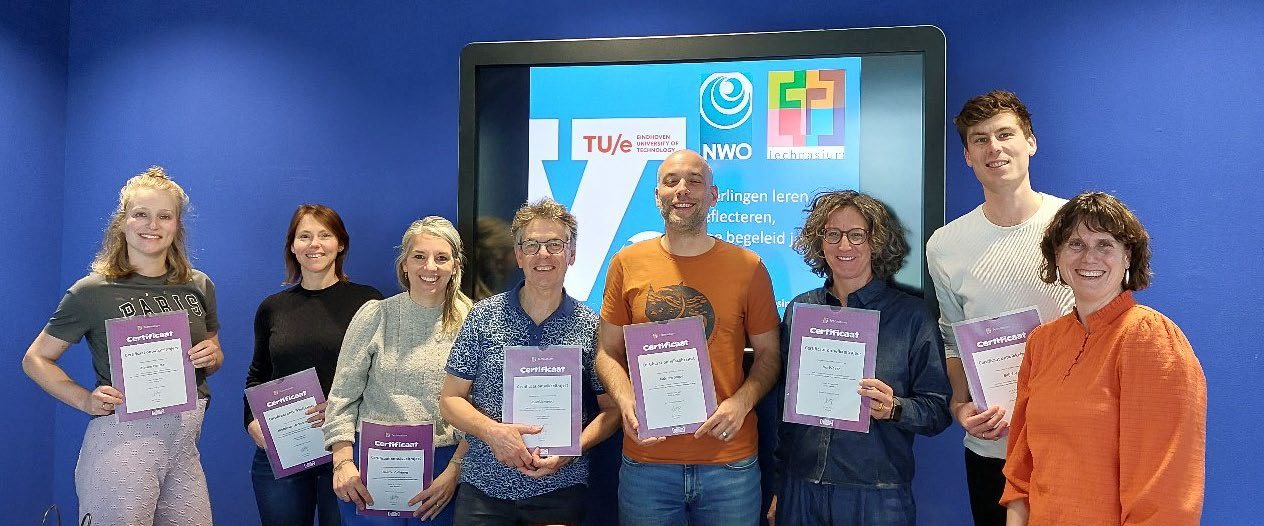
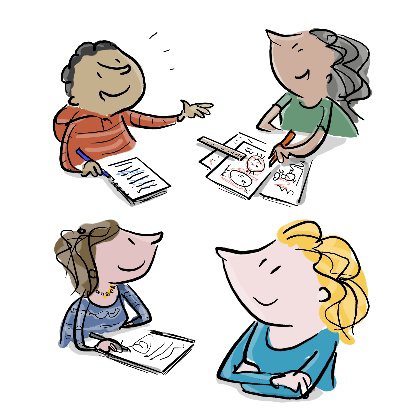
Deelnemers aan het CDR-programma 2022–2024.Participants in the CTR program, 2022–2024.
Opbouw van de inventarisatiestudie en de twee programmajaren (figuur uit het proefschrift).Structure of the inventory study and the two program years (figure from the dissertation).
Studie 1Study 1Hoofdstuk 2Chapter 2
Promoting students’ reflection through process-oriented feedback: teachers’ conceptions, practices and learning needs
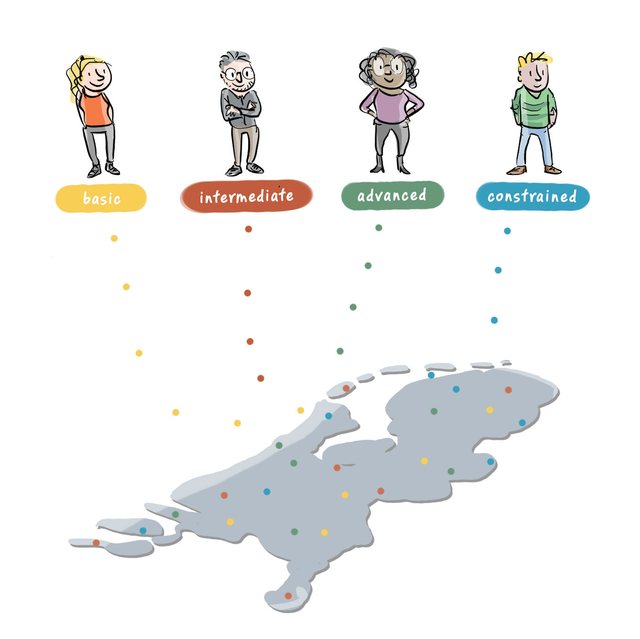
De eerste studie onderzocht de opvattingen, ervaringen en leerbehoeften van docenten met betrekking tot procesgerichte feedback ter bevordering van leerlingreflectie. Focusgroepinterviews met 23 docenten resulteerden in vier profielen: basis, intermediair, gevorderd en gehinderd. Deze profielen laten verschillen zien in de manier waarop docenten feedback en reflectie opvatten en toepassen. De bevindingen gaven inzicht in de professionele leerbehoeften van docenten en vormden de basis voor het ontwerp van het CTR-program. Daarnaast leidde de studie tot een herinterpretatie van het begrip procesgerichte feedback als integraal onderdeel van feedbackgesprekken gericht op leerprocessen en persoonlijke ontwikkeling.
The first study explored teachers’ conceptions, experiences, and learning needs regarding process-oriented feedback aimed at promoting student reflection. Focus group interviews with 23 teachers revealed four profiles (basic, intermediate, advanced, and constrained) indicating variation in how feedback and reflection are understood and enacted in practice. These findings provided insight into teachers’ prior knowledge and professional learning needs and directly informed the design of the program. A further insight was the reconceptualisation of process-oriented feedback. In this study it is understood as an integral element of feedback dialogues concerned with students’ learning processes and personal development.
Transitioning from feedback delivery to feedback dialogue: teachers’ professional growth
De tweede studie onderzocht de professionele groei in het begeleiden van feedbackgesprekken bij tien Technasiumdocenten die deelnamen aan het CTR-program. Hun professionele groei werd beschreven in individuele vignetten op de vijf dimensies: teacher readiness, monitoren of leerlingen klaar zijn voor de feedbackdialoog (student readiness), interactiemodus, feedbackinhoud en het gebruik van geverifieerde observaties. Aan het einde van het program lieten acht docenten groei zien op ten minste twee van deze dimensies. Vooral de ‘teacher readiness’ bleek van belang. Deze vorm van ‘readiness’ omvat het bewustzijn van docenten van hun eigen handelen, de sensitiviteit voor de reacties van leerlingen en het vermogen om een veilige leeromgeving te creëren.
The second study examined professional growth in facilitating feedback dialogues among ten teachers participating in the CTR program. Growth was captured through individual vignettes describing developments across five areas: teacher readiness, monitoring student readiness, interaction mode, feedback content, and the use of verified observations. By the end of the program, eight teachers demonstrated professional growth in at least two of these areas. Particularly noteworthy was the important role of teacher readiness, which encompasses awareness of one’s own behaviour, sensitivity to students’ responses, and the ability to create a psychologically safe environment for dialogue.
“Ik voer nu graag feedbackdialogen en merk dat dit mijn band met leerlingen versterkt.”
“I now enjoy holding feedback dialogues and notice that they strengthen my relationship with students.”
Studie 3Study 3Hoofdstuk 4Chapter 4
Discrepancies in feedback perceptions of STEM teachers and their students: giving or discussing feedback
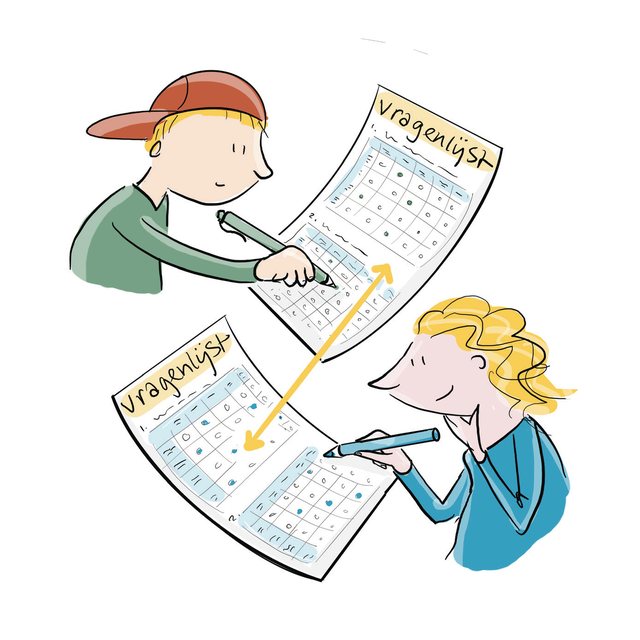
De derde studie onderzocht veranderingen in ervaringen van docenten en leerlingen met feedbackpraktijken tijdens het CTR-program. Op vier meetmomenten werden vragenlijsten afgenomen bij acht docenten en 155 leerlingen. De resultaten laten zien dat in het eerste jaar de docentgestuurde feedback grotendeels behouden bleef of zelfs werd versterkt. De verschuiving naar meer dialogische feedbackpraktijken werd vooral in het tweede jaar zichtbaar. In de meeste klassen rapporteerden leerlingen een toename te ervaren in dialogische feedback. Daarbij werd duidelijk dat de ervaringen van docenten en leerlingen niet altijd met elkaar overeenkwamen: leerlingen beoordeelden de dialogische feedbackpraktijken over het algemeen positiever dan de docenten zichzelf beoordeelden. Dit suggereert dat het meenemen van leerlingperspectieven bij de evaluatie van professionaliseringsprogramma’s waardevolle aanvullende inzichten kan opleveren.
The third study investigated changes in teachers’ and students’ perceptions of feedback practices over the course of the CTR program. Questionnaire data from eight teachers and 155 students were collected at four time points. The findings indicate that teacher-led feedback was generally maintained or strengthened in the first year; however, the transition towards more dialogic feedback practices was partially realised in the second year, with considerable variation across classrooms. Notably, discrepancies between teachers’ and students’ perceptions of feedback practices were apparent in most classes, with students generally reporting more positive experiences of dialogic feedback than their teachers. This suggests that including student perspectives in the evaluation of professional development programs may provide valuable complementary insights.
Gepresenteerd op dePresented at the NARST Annual International Conference, Seattle (2026).
Studie 4Study 4Hoofdstuk 5Chapter 5
Enhancing student reflection through writing tasks and guided teacher support
De vierde studie onderzocht de relatie tussen deelname aan het CTR-program, de begeleidingspraktijken van docenten en de diepte van schriftelijke leerlingreflecties. Acht docenten pasten een op literatuur gebaseerd raamwerk toe met vijf begeleidingsstrategieën: het verduidelijken van het doel van reflectie, het samen formuleren van persoonlijke leerdoelen, het structureren van reflectietaken, het monitoren van reflectiediepte en het voeren van feedbackgesprekken. Na gebruik van het raamwerk rapporteerden docenten meer vertrouwen in en een beter begrip van hun begeleidende rol. Met de geschreven reflecties verdiepten leerlingen hun reflectie richting analytisch niveau, met de sterkste ontwikkeling bij leerlingen die aanvankelijk op een minder diep niveau reflecteerden.
The fourth study examined the relationship between teachers’ participation in the CTR program, their guidance practices, and the depth of students’ written reflections. Eight teachers implemented a literature-based framework of five guidance actions: clarifying the purpose of reflection, co-formulating students’ personal learning goals, structuring reflection tasks, monitoring reflective depth, and conducting feedback dialogues. After using the framework, teachers reported increased confidence and a deeper understanding of their facilitative role. Students’ written reflections showed a shift towards more analytical forms of thinking over time, with the most pronounced development observed among students who initially demonstrated lower levels of reflection.
“Ik vond schriftelijke reflecties eerst niet leuk, maar ik heb er een portfolio mee opgebouwd waarin ik mijn ontwikkeling terugzie. Ik ken nu mijn sterke en zwakke kanten en kan die gericht inzetten.”
“At first I did not like written reflections, but I have built a portfolio with them in which I can see my own development. I now know my strengths and weaknesses and can use them deliberately.”
Professional development in supporting feedback dialogues for students’ reflection
De vijfde studie richtte zich op het ontwerp, de uitvoering en evaluatie van het CTR-program als geheel. In de inventarisatiefase werden acht ontwerpprincipes geïdentificeerd, getoetst en aangescherpt ter ondersteuning van het ontwerp van het professionaliseringsprogram. Deze principes zijn gebruikt als basis voor het ontwerp en de uitvoering van het tweejarige CTR-program.
Na afloop van het CTR-program vond een evaluatie plaats met de deelnemende docenten. De resultaten lieten zien dat docenten hun rol als begeleider hadden geherdefinieerd, vaker feedbackgesprekken voerden en hun begeleidingsvaardigheden hadden ontwikkeld. Daarnaast leidde de evaluatie tot twee aanvullende ontwerpprincipes: de bemiddelende rol van de begeleider bij het vertalen van programma-intenties naar de klassenpraktijk, en het belang van organisatorische randvoorwaarden als factoren die duurzame implementatie mogelijk maken of belemmeren.
The fifth study examined the design, enactment, and evaluation of the CTR program in its entirety. Eight evidence-informed design principles were initially identified. Teachers reconceptualised their role as facilitators, made increasing use of structured feedback dialogues, and demonstrated enhanced reflective competence. The evaluation further yielded two additional design principles: the mediating role of the facilitator in translating program intentions into classroom practice, and the significance of organisational conditions as factors that enable or constrain implementation.
ConclusieConclusion
De bevindingen van dit proefschrift laten zien hoe feedback en reflectie in samenhang kunnen worden behandeld. Bovendien hebben de bevindingen geleid tot een set van onderling samenhangende kenmerken en voorwaarden voor de professionele ontwikkeling van docenten die feedback en reflectie in samenhang willen toepassen binnen het vak O&O op Technasiumscholen. Door docenten te laten ervaren hoe feedback reflectie kan stimuleren en hoe reflectie de interpretatie van feedback verdiept, kan een consistenter begrip van beide processen ontstaan. Daarnaast vraagt het ontwikkelen van deze competenties om structurele tijd en ondersteuning. Een professionaliseringstraject dat dit ondersteunt moet ruimte bieden voor experimenteren, reflecteren en bijstellen. Op schoolniveau zijn tijd, collegiale samenwerking en steun van de schoolleiding noodzakelijk om feedbackgesprekken en reflectieve begeleiding duurzaam te integreren in de onderwijspraktijk.
Bovendien blijkt de rol van leerlingen eveneens van belang in de professionele ontwikkeling van docenten. Leerlingen signaleren vaak als eerste veranderingen in de onderwijspraktijk en kunnen waardevolle inzichten geven in de invloed daarvan. Hun ervaringen met feedbackgesprekken en reflectie vormen daarmee een belangrijke bron voor het begrijpen en verdiepen van professionele groei van docenten. Dit onderzoek heeft ook implicaties voor het O&O-curriculum. Diepgaande reflectie en feedbackdialogen vragen om structurele inbedding en voldoende onderwijstijd binnen het O&O-vak. Ontwikkelingen waarbij deze tijd onder druk komt te staan, kunnen de condities ondermijnen die nodig zijn om deze praktijken duurzaam te laten slagen.
Samenvattend laat dit proefschrift zien dat effectieve professionele ontwikkeling om een samenhangend geheel vraagt van conceptuele helderheid, ervaringsgericht leren, praktische ondersteuning en structurele condities. Alleen in een omgeving waarin deze elementen op elkaar zijn afgestemd, kunnen docenten zich professionaliseren in het faciliteren van feedbackdialogen die ondersteunend zijn aan diepe leerlingreflectie.
In conclusion, the findings of all studies indicate that professional development aimed at enabling teachers to facilitate feedback dialogues and support students’ reflection should integrate conceptual understanding, practical pedagogical tools, and experiential learning opportunities. Rather than treating feedback and reflection as separate domains, professional development should support teachers in understanding how feedback can stimulate reflection and how reflection, in turn, deepens the interpretation and uptake of feedback. This coherent understanding of both processes as interconnected and dialogic forms the foundation for their effective enactment in classroom practice. These elements also enable teachers to engage with feedback and reflection from both a teacher and learner perspective.
The role of students in professional development also warrants attention, as they are often the first to signal changes in classroom practice and can provide valuable insights into their impact. Finally, the analysis of the CTR program shows that effective professional development requires a coherent integration of conceptual understanding, experiential learning, practical support, and enabling structural conditions. Only within an environment in which these elements are aligned can participating teachers sustainably develop and enact dialogic feedback practices and reflective guidance.
ProefschriftDissertation
Blader door het proefschriftBrowse the dissertation
Het volledige proefschrift is vrij toegankelijk. U kunt het hieronder doorbladeren of als PDF downloaden. Klik op een hoofdstuk om direct naar die pagina te gaan.
The full dissertation is openly available. You can browse it below or download it as a PDF. Select a chapter to go straight to that page.
Ik combineer met veel plezier twee werelden. Tijdens mijn promotietraject gaf ik twee dagen per week Onderzoek & Ontwerpen (O&O) in het voortgezet onderwijs (Varendonck College) en werkte ik drie dagen per week als onderzoeker aan de Technische Universiteit Eindhoven. Die afwisseling hield me scherp en bood steeds nieuwe uitdagingen.
Na het opzetten van een goedlopend Technasium groeide mijn interesse in de procesmatige kant van O&O. Waar het product laat zien wat leerlingen samen maken, laat het proces zien hoe zij zich als persoon ontwikkelen. Hoewel het vak O&O inhoudelijk sterk is uitgewerkt, zag ik juist op dit procesmatige vlak nog veel mogelijkheden voor verdieping en verbetering.
In 2015 ben ik in contact gekomen met de Eindhoven School of Education (ESoE) van de TU/e om mijn wens voor promotieonderzoek te verkennen. Op advies startte ik eerst met de universitaire research master Onderwijswetenschappen aan de Open Universiteit, een keuze waar ik geen moment spijt van heb gehad. Deze studie heb ik in 2019 afgerond met een 8 voor mijn masterthesis.
Dankzij een lerarenpromotiebeurs van de NWO kon ik in september 2021 beginnen aan mijn promotietraject. Binnen de ESoE was ik de eerste twee jaar lid van de onderzoeksgroep van prof.dr. Jan Vermunt en de laatste drie jaar van de groep van prof.dr. Nienke Nieveen. Op 2 oktober 2026 heb ik mijn proefschrift verdedigd aan de Technische Universiteit Eindhoven.
I very much enjoy combining two worlds. During my doctoral research, I spent two days a week teaching Research & Design (R&D, in Dutch Onderzoek & Ontwerpen) in secondary education at Varendonck College and three days a week working as a researcher at Eindhoven University of Technology. That variety kept me sharp and continually offered new challenges.
After setting up a well-functioning Technasium, my interest grew in the process side of R&D. Whereas the product shows what students create together, the process shows how they develop as individuals. Although the subject R&D is thoroughly developed in terms of content, I saw considerable room for deepening and improvement in precisely this process side.
In 2015 I approached the Eindhoven School of Education (ESoE) at TU/e to explore my wish to undertake doctoral research. On their advice, I first enrolled in the research master’s programme in Educational Sciences at the Open University of the Netherlands, a choice I have never regretted. I completed this programme in 2019, with a grade of 8 for my master’s thesis.
Thanks to a teacher PhD grant from NWO, I was able to start my doctoral research in September 2021. Within ESoE, I was a member of Professor Jan Vermunt’s research group for the first two years and of Professor Nienke Nieveen’s group for the final three years. On 2 October 2026 I defended my dissertation at Eindhoven University of Technology.
Loopbaan en opleidingCareer and education
2 oktober 20262 October 2026Promotie aan de Technische Universiteit EindhovenDoctorate, Eindhoven University of Technology
2021–2026Promotieonderzoek aan de Eindhoven School of Education (TU/e), parttimePart-time doctoral research at the Eindhoven School of Education (TU/e)
2015–2019Research master Onderwijswetenschappen, Open Universiteit; masterthesis beoordeeld met een 8Research master’s in Educational Sciences, Open University of the Netherlands; master’s thesis awarded a grade of 8
sinds 1997since 1997Docente natuur en techniek en O&O en technator aan het Varendonck College in Asten, waar zij het Technasium opzetteTeacher of science and technology and R&D, and Technasium coordinator (technator), at Varendonck College in Asten, where she set up the Technasium
DaarvoorEarlierLerarenopleiding ontwerpen en techniek aan de Pedagogische Technische Hogeschool in Eindhoven; bevoegdheid voor onderwijs aan leerlingen met speciale onderwijsbehoeften (Seminarium voor Orthopedagogiek, Hogeschool Utrecht)Teacher education in design and technology at the Pedagogische Technische Hogeschool in Eindhoven; qualification for teaching students with special educational needs (Seminarium voor Orthopedagogiek, Utrecht University of Applied Sciences)
PublicatiesPublications
Publicaties en presentatiesPublications and presentations
ProefschriftDissertation
Görtzen, J. J. H. (2026). Professional development of secondary school teachers in facilitating feedback dialogues and student reflection [ProefschriftDoctoral dissertation, Eindhoven University of Technology]. https://doi.org/10.6100/t189-j683
Artikelen in wetenschappelijke tijdschriftenPeer-reviewed journal articles
Görtzen, J. J. H., Schellings, G. L. M., & Nieveen, N. M. (2026). Enhancing students’ reflection through writing tasks and guided teachers’ support. Reflective Practice. https://doi.org/10.1080/14623943.2026.2701199open access
Görtzen, J. J. H., Stollman, S. H. M., Schellings, G. L. M., Vermunt, J. D., & Nieveen, N. M. (2025). Promoting students’ reflection through process-oriented feedback: Teachers’ conceptions, practices and learning needs. Studies in Educational Evaluation, 86, 101483. https://doi.org/10.1016/j.stueduc.2025.101483open access
ConferentiebijdragenConference contributions
Görtzen, J. J. H., Schellings, G. L. M., & Nieveen, N. M. (2026). Feedback dialogues to support students’ reflection: Design and evaluation of a teachers’ professional development program [Paper]. European Conference on Educational Research (ECER).
Görtzen, J. J. H., Schellings, G. L. M., & Nieveen, N. M. (2026, April 19–22). Discrepancies in feedback perceptions of STEM teachers and their students: Giving or discussing feedback [Paper presentation]. NARST Annual International Conference, Seattle, USA.
Görtzen, J. J. H., Schellings, G. L. M., & Nieveen, N. M. (2025, June 4–6). Overgang van feedback geven naar een feedbackdialoog: Professionele groei van VO-docenten op vijf kerngebieden [Paper presentation]. Onderwijs Research Dagen, Leuven, BelgiëBelgium.
Görtzen, J. J. H., Schellings, G. L. M., & Nieveen, N. M. (2024, July 10–12). Feedback op reflectieprocessen van leerlingen: Kloof tussen theorie en praktijk [Discussion table]. Onderwijs Research Dagen, Tilburg, Nederlandthe Netherlands.
Görtzen, J. J. H., Stollman, S. H. M., Schellings, G. L. M., & Vermunt, J. D. H. M. (2023, July 5–7). Leerlingen leren reflecteren, hoe begeleid je dat? [Paper presentation]. Onderwijs Research Dagen, Amsterdam, Nederlandthe Netherlands.
Görtzen, J. J. H., Stollman, S. H. M., Schellings, G. L. M., & Vermunt, J. D. H. M. (2023, July). Collaboratieve Docent Reflectie traject: Leren procesgerichte feedback geven [Discussion table]. Onderwijs Research Dagen, Amsterdam, Nederlandthe Netherlands.
Görtzen, J. J. H., Stollman, S. H. M., Schellings, G. L. M., & Vermunt, J. D. H. M. (2022, July 6–8). Van visie tot uitvoering: Leren reflecteren, hoe begeleid je dat? [Discussion table]. Onderwijs Research Dagen, Hasselt, BelgiëBelgium.
Görtzen, J. J. H., Stollman, S. H. M., Schellings, G. L. M., & Vermunt, J. D. H. M. (2022, March 17–18). Learning to reflect, how do you guide that? [Poster presentation]. ICO Spring School, online.
Workshops en webinarsWorkshops and webinars
Görtzen, J. J. H. (2026, 7 septemberSeptember 7). Sterke feedbackdialogen voeren [Webinar]. Stichting Technasium.
Görtzen, J. J. H., Schellings, G. L. M., Schellekens, A., & Nieveen, N. M. (2026, March 16–17). Feedbackdialoog en reflectie binnen het Technasium: een eye-opener voor alle onderwijscontexten [Workshop]. VELON, Amsterdam, Nederlandthe Netherlands.
Görtzen, J. J. H., Schellings, G. L. M., van de Vossenberg, N., & Nieveen, N. M. (2025, March 10–11). Leerlingen leren reflecteren: Bespreken van procesgerichte feedback [Workshop]. VELON, Rotterdam, Nederlandthe Netherlands.
MasterthesisMaster’s thesis
Görtzen, J. J. H. (2019). Reflecteren moet dat echt? Het effect van een video verrijkte rubriek voor de vaardigheid samenwerken, ter ondersteuning van de doeloriëntatie, op de motivatie voor en het niveau van reflecteren van Technasiumleerlingen [MasterthesisMaster’s thesis, Open Universiteit]. Open Universiteit research portal
Artikel naar aanleiding van de masterthesis:Article based on the master’s thesis:Reflecteren, moet dat echt?Script!-onderzoek (OMO).
Data
De onderliggende data van het proefschrift en het bijbehorende reflectielogboek zijn gearchiveerd bij 4TU.ResearchData (2026).
The data underlying the dissertation and the accompanying reflection log are archived at 4TU.ResearchData (2026).
PromotiePublic defence
De verdediging op 2 oktober 2026The public defence on 2 October 2026
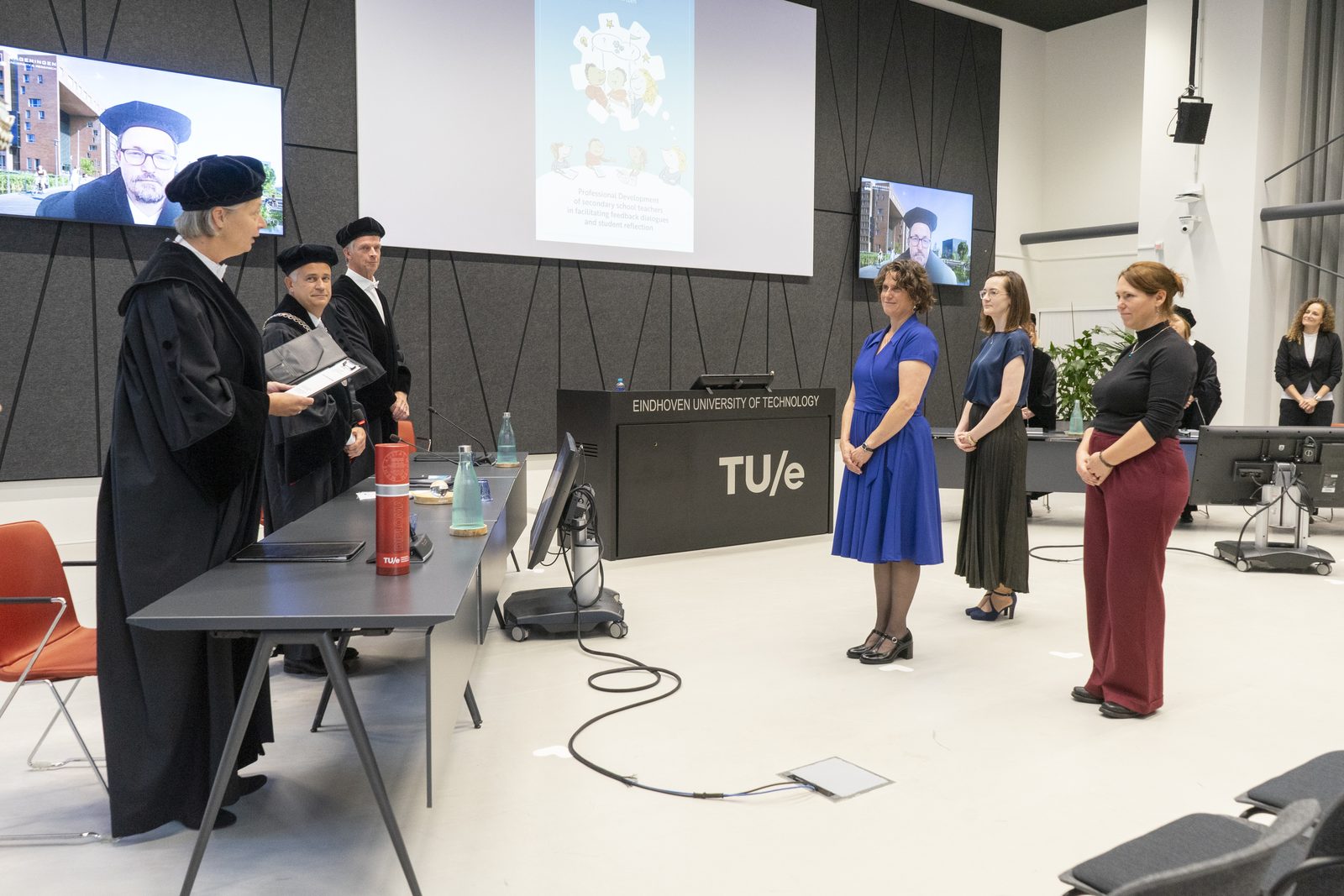
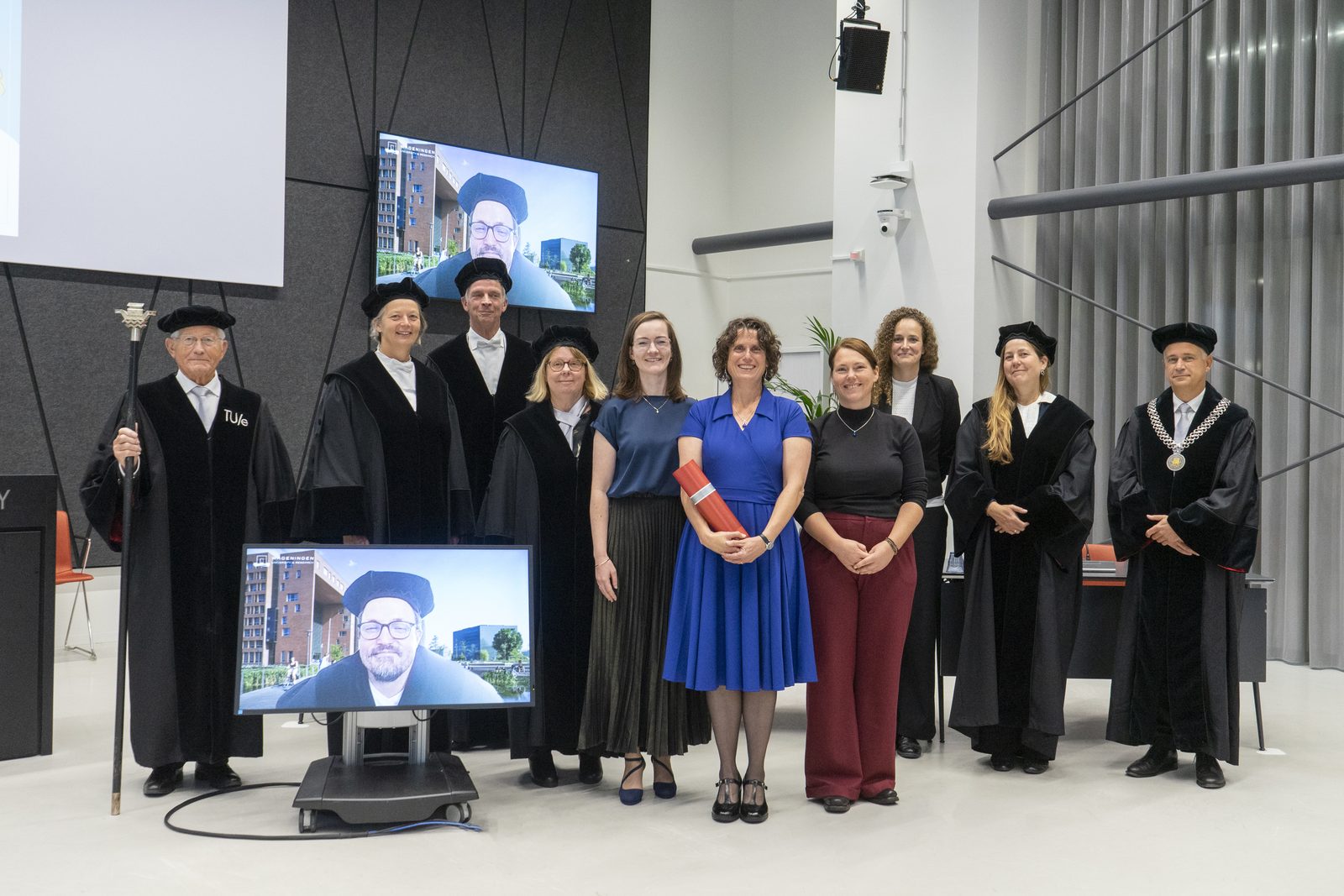
Op vrijdag 2 oktober 2026 om 11.00 uur verdedigde Josine Görtzen haar proefschrift in het openbaar aan de Technische Universiteit Eindhoven.
On Friday 2 October 2026 at 11.00, Josine Görtzen publicly defended her dissertation at Eindhoven University of Technology.
PromotiecommissieDoctoral committee
voorzitterchairprof.dr. C. Storm
1e promotorfirst supervisorprof.dr. N.M. Nieveen
2e promotorsecond supervisordr. G.L.M. Schellings
ledenmembersdr. R.A.M. de Kleijn (Universiteit UtrechtUtrecht University) dr. E.M. Rusman (Open Universiteit) prof.dr. P.J. den Brok (Wageningen UniversiteitWageningen University) prof.dr. J.T. van der Veen
paranimfenparanymphsNeeltje van de Vossenberg Ilse Maessen
Hoe verloopt een promotie in Nederland?How does a public defence work in the Netherlands?
Een proefschrift wordt eerst goedgekeurd door de promotoren. Daarna beoordeelt een promotiecommissie van deskundigen, ook van andere universiteiten, het manuscript. Pas na hun goedkeuring wordt het proefschrift gedrukt en wordt een datum voor de openbare verdediging vastgesteld.
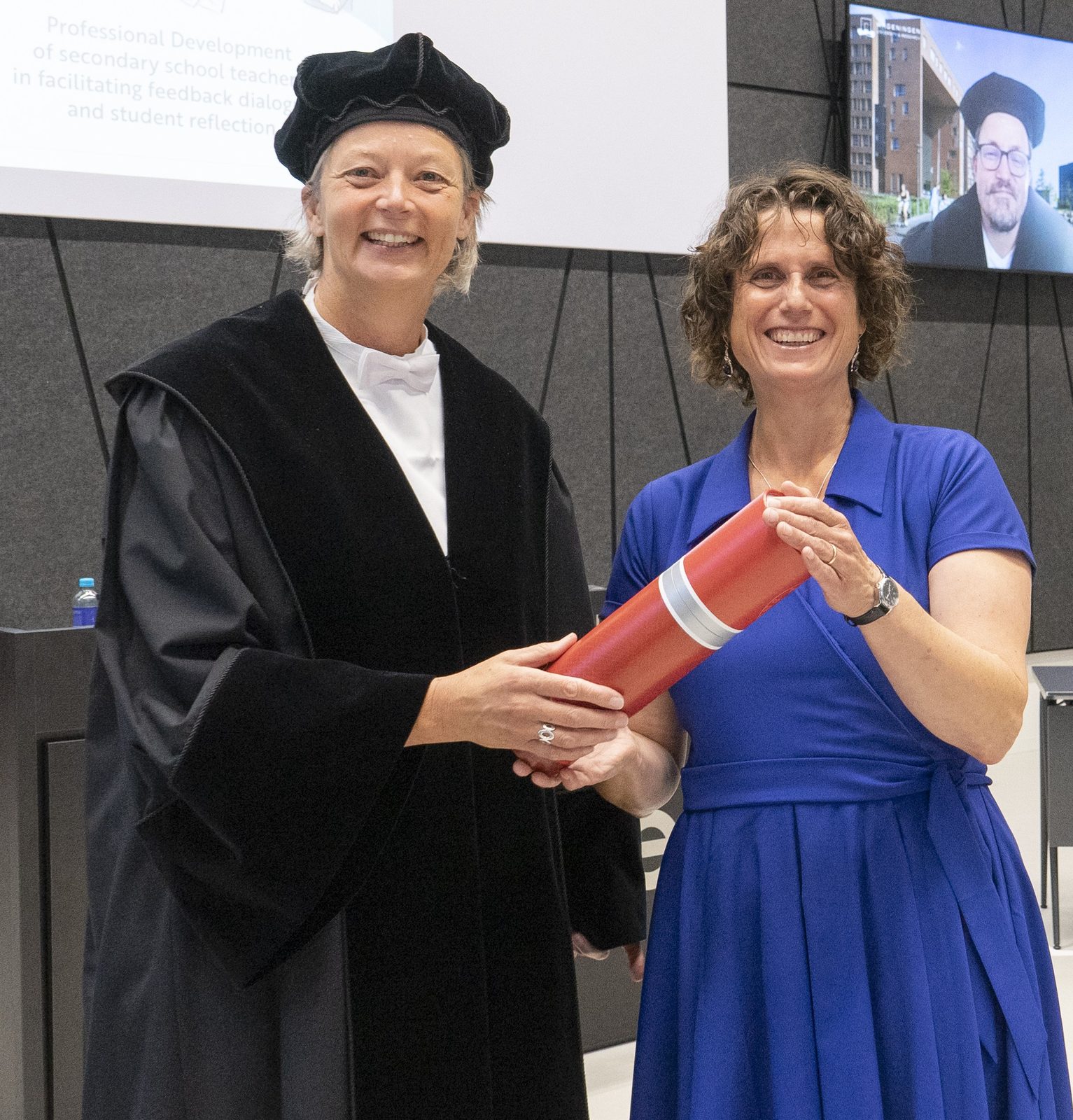
Tijdens de verdediging licht de promovendus het onderzoek kort toe voor het publiek: het lekenpraatje. Daarna stellen de leden van de commissie om beurten vragen. De promovendus wordt bijgestaan door twee paranimfen. Na de vastgestelde tijd betreedt de pedel de zaal met de woorden ‘Hora est’ (het is tijd), waarna de commissie zich terugtrekt om te beraadslagen. Bij terugkomst wordt de doctorsgraad verleend en ontvangt de promovendus de bul.
In Nederland is de officiële titel doctor (dr.); internationaal wordt vaak de afkorting PhD gebruikt.
A dissertation is first approved by the supervisors (promotoren). A doctoral committee of experts, including members from other universities, then assesses the manuscript. Only after their approval is the dissertation printed and a date set for the public defence.
During the defence, the candidate first gives a short presentation of the research for the audience, known as the lekenpraatje (layperson’s talk). The members of the committee then take turns to ask questions. The candidate is accompanied by two paranymphs. When the allotted time has passed, the beadle (pedel) enters the room and announces ‘Hora est’ (it is time), after which the committee withdraws to deliberate. On its return, the doctoral degree is conferred and the candidate receives the doctoral diploma.
In the Netherlands the official title is doctor (dr.); internationally, the abbreviation PhD is commonly used.
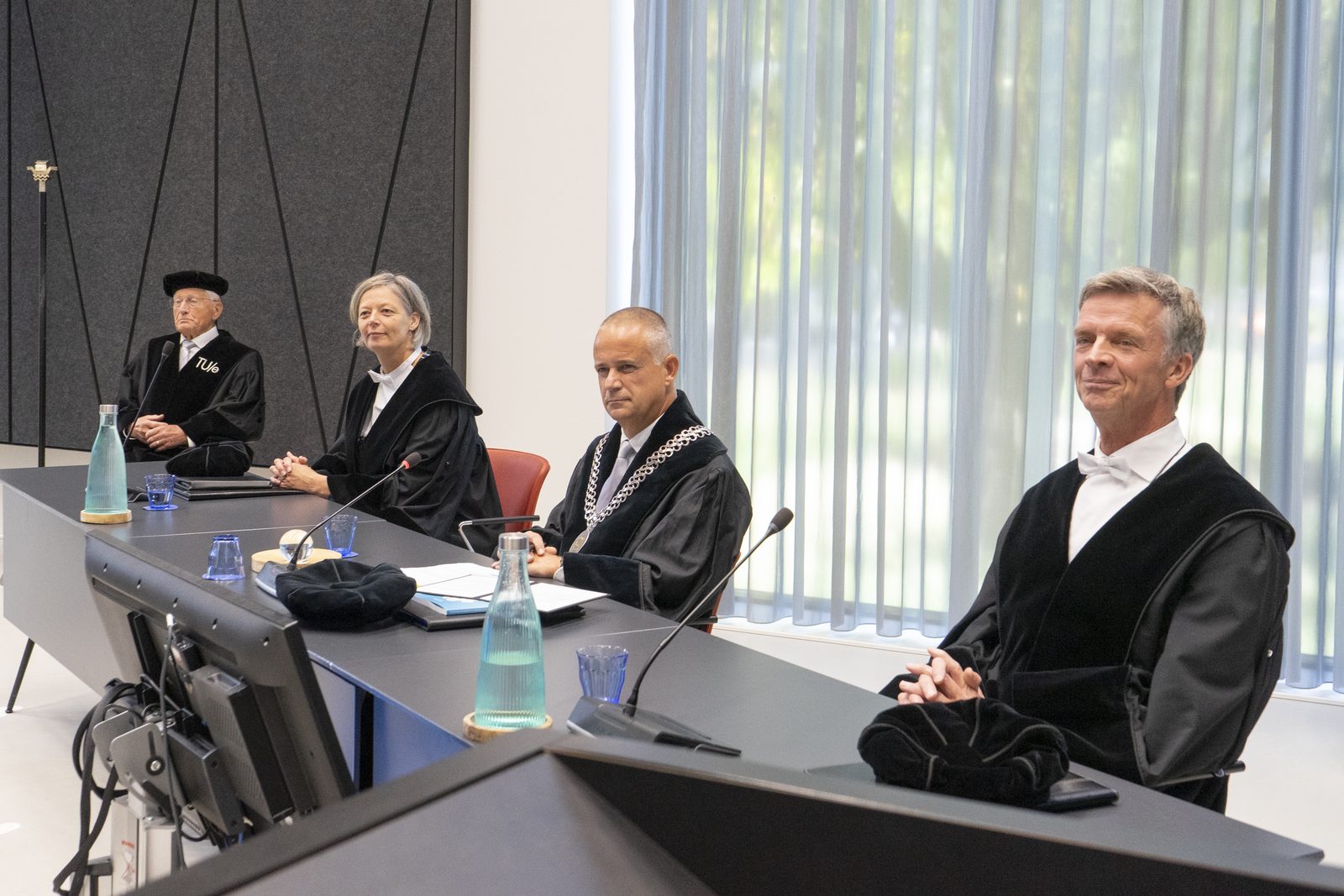
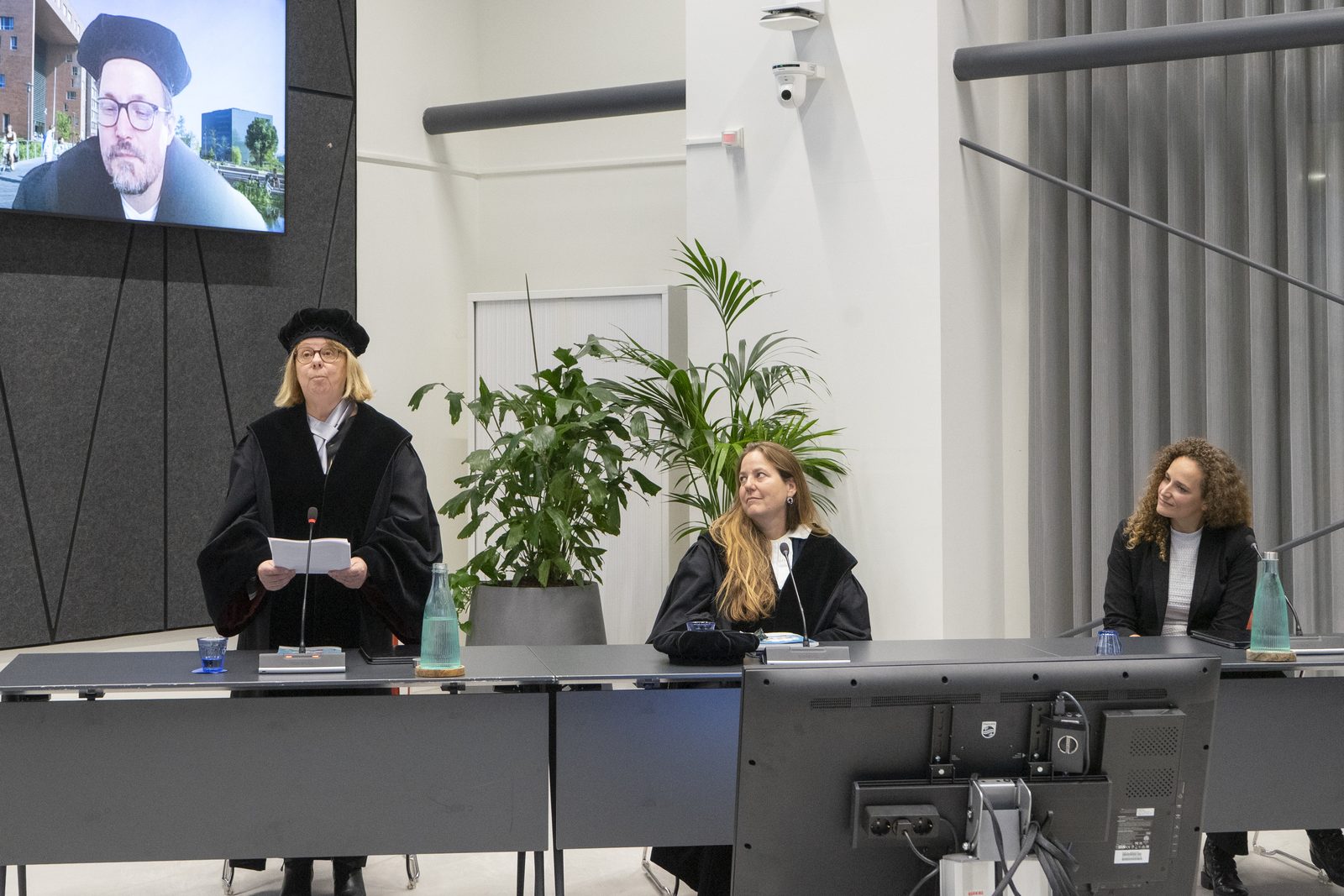
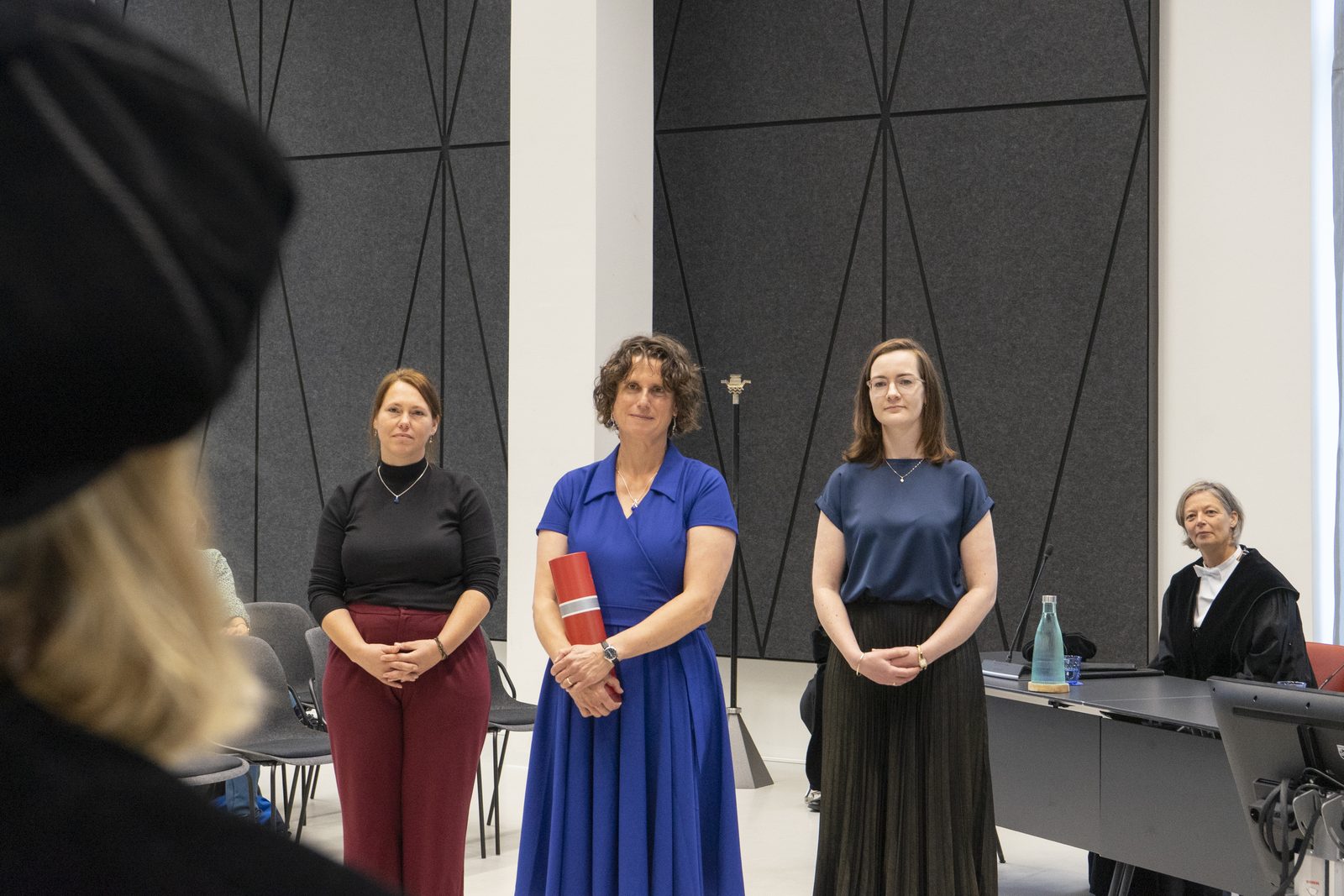
Beelden van de promotie op 2 oktober 2026. Klik op een foto voor een grotere weergave. Foto’s: Maartje Mulder (TU/e).Photographs of the defence on 2 October 2026. Click a photo to view it larger. Photos: Maartje Mulder (TU/e).
Presentatie bij de verdedigingPresentation at the defence
De dia’s van het lekenpraatje (Nederlandstalig, 11 dia’s). Blader met de pijlen, of veeg op een telefoon of tablet.
The slides of the layperson’s talk (in Dutch, 11 slides). Use the arrows to browse, or swipe on a phone or tablet.
De literatuur waarnaar in het proefschrift wordt verwezen (110 bronnen).
The literature cited in the dissertation (110 sources).
Adarkwah, M. A. (2021). The power of assessment feedback in teaching and learning: A narrative review and synthesis of the literature. SN Social Sciences, 1, 75. https://doi.org/10.1007/s43545-021-00086-w
Ajjawi, R., & Boud, D. (2017). Researching feedback dialogue: An interactional analysis approach. Assessment and Evaluation in Higher Education, 42(2), 252–265. https://doi.org/10.1080/02602938.2015.1102863
Ajjawi, R., Olson, R. E., & McNaughton, N. (2022). Emotion as reflexive practice: A new discourse for feedback practice and research. Medical Education, 56(5), 480–488. https://doi.org/10.1111/medu.14700
Akkerman, S., Admiraal, W., Brekelmans, M., & Oost, H. (2008). Auditing quality of research in social sciences. Quality and Quantity, 42(2), 257–274. https://doi.org/10.1007/s11135-006-9044-4
Ananiadou, K., & Claro, M. (2009). 21st century skills and competences for new millennium learners in OECD countries. OECD Education Working Papers, 41. https://doi.org/10.1787/218525261154
Antoniou, P., & Kyriakides, L. (2013). A dynamic integrated approach to teacher professional development: Impact and sustainability of the effects on improving teacher behaviour and student outcomes. Teaching and Teacher Education, 29(1), 1–12. https://doi.org/10.1016/j.tate.2012.08.001
Barr, N., Hartley, K., Lopata, J. A., McFarlane, B., & Mcnamara, M. J. (2022). Learning in an uncertain world: Transforming higher education for the Anthropocene. In R. A. Beghetto & G. J. Jaeger (Eds.), Uncertainty: A catalyst for creativity, learning and development (pp. 337–357). Springer International Publishing. https://doi.org/10.1007/978-3-030-98729-9_18
Bock, T., Thomm, E., Bauer, J., & Gold, B. (2024). Fostering student teachers' research-based knowledge of effective feedback. European Journal of Teacher Education, 47(2), 389–407. https://doi.org/10.1080/02619768.2024.2338841
Boodt, S. (2014). Making observation feedback effective. The ESOL Journal, 25(1), 9–15.
Borko, H., Jacobs, J., & Koellner, K. (2010). Contemporary approaches to teacher professional development. In P. Peterson, E. Baker, & B. McGaw (Eds.), International encyclopedia of education (3rd ed., pp. 548–556). Elsevier. https://doi.org/10.1016/B978-0-08-044894-7.00654-0
Boud, D., & Dawson, P. (2021). What feedback literate teachers do: An empirically-derived competency framework. Assessment and Evaluation in Higher Education, 48(2), 158–171. https://doi.org/10.1080/02602938.2021.1910928
Boud, D., & Molloy, E. (2013). Rethinking models of feedback for learning: The challenge of design. Assessment and Evaluation in Higher Education, 38(6), 698–712. https://doi.org/10.1080/02602938.2012.691462
Braun, V., & Clarke, V. (2021). One size fits all? What counts as quality practice in (reflexive) thematic analysis? Qualitative Research in Psychology, 18(3), 328–352. https://doi.org/10.1080/14780887.2020.1769238
Broekkamp, H., & van Hout-Wolters, B. (2007). The gap between educational research and practice: A literature review, symposium, and questionnaire. Educational Research and Evaluation, 13(3), 203–220. https://doi.org/10.1080/13803610701626127
Cañas, A. J., Novak, J. D., & Reiska, P. (2015). How good is my concept map? Am I a good Cmapper? Knowledge Management & E-Learning: An International Journal, 7(1), 6–19. https://doi.org/10.34105/j.kmel.2015.07.002
Carless, D., & Boud, D. (2018). The development of student feedback literacy: Enabling uptake of feedback. Assessment & Evaluation in Higher Education, 43(8), 1315–1325. https://doi.org/10.1080/02602938.2018.1463354
Carless, D., & Winstone, N. (2020). Teacher feedback literacy and its interplay with student feedback literacy. Teaching in Higher Education, 28(1), 150–163. https://doi.org/10.1080/13562517.2020.1782372
Coulson, D., & Harvey, M. (2013). Scaffolding student reflection for experience-based learning: A framework. Teaching in Higher Education, 18(4), 401–413. https://doi.org/10.1080/13562517.2012.752726
Creswell, J. W. (2014). Educational research: Planning, conducting, and evaluating quantitative and qualitative research (4th ed.). Pearson.
Dai, W., Tsai, Y. S., Gašević, D., & Chen, G. (2025). Designing relational feedback: A rapid review and qualitative synthesis. Assessment and Evaluation in Higher Education, 50(1), 16–30. https://doi.org/10.1080/02602938.2024.2361166
Dam, M. (2014). Making educational reforms practical for teachers: Using a modular, success-oriented approach to make a context-based educational reform practical for implementation in Dutch biology education [Doctoral dissertation, Leiden University]. Leiden University Repository.
de Kleijn, R. A. M. (2021). Supporting student and teacher feedback literacy: An instructional model for student feedback processes. Assessment and Evaluation in Higher Education, 48(2), 186–200. https://doi.org/10.1080/02602938.2021.1967283
den Brok, P., Bergen, T., Stahl, R. J., & Brekelmans, M. (2004). Students' perceptions of teacher control behaviours. Learning and Instruction, 14(4), 425–443. https://doi.org/10.1016/j.learninstruc.2004.01.004
Desimone, L. M. (2023). Rethinking teacher PD: A focus on how to improve student learning. Professional Development in Education, 49(1), 1–3. https://doi.org/10.1080/19415257.2023.2162746
Doulougeri, K., Vermunt, J. D., Bombaerts, G., & Bots, M. (2024). Challenge-based learning implementation in engineering education: A systematic literature review. Journal of Engineering Education, 113, 1076–1106. https://doi.org/10.1002/jee.20588
Doyle, W., & Ponder, G. A. (1977). The practicality ethic in teacher decision-making. Interchange, 8(3), 1–12. https://doi.org/10.1007/BF01189290
Esser-Noethlichs, M., Lund, S., & Bjørke, L. (2024). 'Facilitating change from within': Investigating students' experiences of using core reflection in physical education teacher education. Physical Education and Sport Pedagogy. https://doi.org/10.1080/17408989.2024.2400069
European Parliament & Council of the European Union. (2016). Regulation (EU) 2016/679 of the European Parliament and of the Council of 27 April 2016 on the protection of natural persons with regard to the processing of personal data and on the free movement of such data (General Data Protection Regulation). Official Journal of the European Union, L 119, 1–88. https://eur-lex.europa.eu/eli/reg/2016/679/oj
Evans, C. (2015). Exploring students' emotions and emotional regulation of feedback in the context of learning to teach. In V. Donche, S. De Maeyer, D. Gijbels, & H. van den Bergh (Eds.), Methodological challenges in research on student learning (pp. 107–160). Garant.
Gadsby, H. (2022). Fostering reflective practice in Post Graduate Certificate in Education students through the use of reflective journals: Developing a typology for reflection. Reflective Practice, 23(3), 357–368. https://doi.org/10.1080/14623943.2022.2028612
Garino, A. (2020). Ready, willing and able: A model to explain successful use of feedback. Advances in Health Sciences Education, 25(2), 337–361. https://doi.org/10.1007/s10459-019-09924-2
Gordijn, F., Eernstman, N., Helder, J., & Brouwer, H. (2018). Reflection methods: Practical guide for trainers and facilitators. Wageningen Centre for Development Innovation. https://doi.org/10.18174/439461
Görtzen, J. (2019). Reflecteren moet dat echt? Het effect van een video verrijkte rubriek voor de vaardigheid samenwerken, ter ondersteuning van de doeloriëntatie, op de motivatie voor en het niveau van reflecteren van technasium leerlingen [Is reflecting really necessary? Effects of a video-enriched rubric on collaboration skills, goal orientation, and motivation to reflect] [Master's thesis, Open University].
Görtzen, J. J. H., Schellings, G. L. M., & Nieveen, N. M. (2026a, April 19). Discrepancies in feedback perceptions of STEM teachers and their students: Giving or discussing feedback [Paper presentation]. NARST 2026 Annual International Conference, Seattle.
Görtzen, J. J. H., Schellings, G. L. M., & Nieveen, N. M. (2026b). Leerlingen leren reflecteren, hoe begeleid je dat [Learning to reflect, how do you guide that?] Internal report. Eindhoven University of Technology.
Görtzen, J. J. H., Stollman, S. H. M., Schellings, G. L. M., Vermunt, J. D., & Nieveen, N. M. (2025). Promoting students' reflection through process-oriented feedback: Teachers' conceptions, practices and learning needs. Studies in Educational Evaluation, 86, 101483. https://doi.org/10.1016/j.stueduc.2025.101483
Guskey, T. R. (2002). Professional development and teacher change. Teachers and Teaching: Theory and Practice, 8(3), 381–391. https://doi.org/10.1080/135406002100000512
Harvey, M., Coulson, D., & McMaugh, A. (2016). Towards a theory of the ecology of reflection: Reflective practice for experiential learning in higher education. Journal of University Teaching and Learning Practice, 13(2). https://doi.org/10.53761/1.13.2.2
Hattie, J., & Timperley, H. (2007). The power of feedback. Review of Educational Research, 77(1), 81–112.
Hattie, J., & Yates, G. (2014). Using feedback to promote learning. In V. A. Benassi, C. E. Overson, & C. M. Hakala (Eds.), Applying science of learning in education: Infusing psychological science into the curriculum (pp. 45–58). Society for Teaching of Psychology.
Heemsoth, T., & Heinze, A. (2016). Secondary school students learning from reflections on the rationale behind self-made errors: A field experiment. Journal of Experimental Education, 84(1), 98–118. https://doi.org/10.1080/00220973.2014.963215
Hilden, S., & Tikkamäki, K. (2013). Reflective practice as a fuel for organizational learning. Administrative Sciences, 3(3), 76–95. https://doi.org/10.3390/admsci3030076
Hmelo-Silver, C. E. (2004). Problem-based learning: What and how do students learn? Educational Psychology Review, 16(3), 235–266.
Hoogendijk, K., Holland, J. G., Tick, N. T., Hofman, A. W. H., Severiens, S. E., Vuijk, P., Maras, A., & van Veen, D. (2020). Effect of Key2Teach on Dutch teachers' relationships with students with externalizing problem behaviour: A randomized controlled trial. European Journal of Psychology of Education, 35(1), 111–135. https://doi.org/10.1007/s10212-019-00415-x
Kangas-Dick, K., & O'Shaughnessy, E. (2020). Interventions that promote resilience among teachers: A systematic review of the literature. International Journal of School and Educational Psychology, 8(2), 131–146. https://doi.org/10.1080/21683603.2020.1734125
Karamane, E., Vatou, A., Tsigilis, N., & Gregoriadis, A. (2023). Comparing students' and teachers' perceptions about teachers' interpersonal behaviour in Greek secondary education. Learning Environments Research, 26(3), 899–914. https://doi.org/10.1007/s10984-023-09459-9
Kluger, A. N., & DeNisi, A. (1996). The effects of feedback interventions on performance: A historical review, a meta-analysis, and a preliminary feedback intervention theory. Psychological Bulletin, 119(2), 254–284. https://doi.org/10.1037/0033-2909.119.2.254
Knowles, M. S. (1980). The modern practice of adult education: From pedagogy to andragogy. Religious Education, 75(4), 202–211.
Korthagen, F., & Nuijten, E. (2022). The power of reflection in teacher education and professional development: Strategies for in-depth teacher learning. Routledge.
Korthagen, F., & Vasalos, A. (2005). Levels in reflection: Core reflection as a means to enhance professional growth. Teachers and Teaching: Theory and Practice, 11(1), 47–71. https://doi.org/10.1080/1354060042000337093
Lapidot-Lefler, N., & Israel, L. (2024). Listening to my own and others' voices: The experience of participants in teacher-education learning communities. Teacher Development. https://doi.org/10.1080/13664530.2024.2435883
Lipnevich, A. A., & Panadero, E. (2021). A review of feedback models and theories: Descriptions, definitions, and conclusions. Frontiers in Education, 6, Article 720195. https://doi.org/10.3389/feduc.2021.720195
Louws, M. L., Meirink, J. A., van Veen, K., & van Driel, J. H. (2017). Teachers' self-directed learning and teaching experience: What, how, and why teachers want to learn. Teaching and Teacher Education, 66, 171–183. https://doi.org/10.1016/j.tate.2017.04.004
McKenney, S., & Reeves, T. C. (2025). Educational design research for relevant & robust scholarship. Journal of Computing in Higher Education, 37(2), 614–638. https://doi.org/10.1007/s12528-025-09456-2
Mezirow, J. (1997). Transformative learning: Theory to practise. New Directions for Adult and Continuing Education, 1997(74), 5–12. https://doi.org/10.1002/ace.7401
Miles, M. B., Huberman, A. M., & Saldana, J. (2014). Qualitative data analysis: An expanded sourcebook (3rd ed.). Sage.
Nguyen, Q. N. (2022). Postlesson affordance-based reflective discussion in ELT classes. TESOL Journal, 13(4). https://doi.org/10.1002/tesj.677
Nicol, D. (2021). The power of internal feedback: Exploiting natural comparison processes. Assessment & Evaluation in Higher Education, 46(5), 756–778.
Nieminen, J. H., & Carless, D. (2023). Feedback literacy: A critical review of an emerging concept. Higher Education, 85(6), 1381–1400. https://doi.org/10.1007/s10734-022-00895-9
OECD. (2025). Skills that matter for success and well-being in adulthood (OECD Skills Studies). OECD Publishing. https://doi.org/10.1787/6e318286-en
Overman, M., Vermunt, J. D., Meijer, P. C., Bulte, A. M. W., & Brekelmans, M. (2014). Students' perceptions of teaching in context-based and traditional chemistry classrooms: Comparing content, learning activities, and interpersonal perspectives. International Journal of Science Education, 36(11), 1871–1901. https://doi.org/10.1080/09500693.2013.880004
Paulson Gjerde, K., Padgett, M. Y., & Skinner, D. (2017). The impact of process vs. outcome feedback on student performance and perceptions. Journal of Learning in Higher Education, 13(1), 73–82.
Pintrich, P. R. (2004). A conceptual framework for assessing motivation and self-regulated learning in college students. Educational Psychology Review, 16(4), 385–407.
Priestley, M., & Drew, V. (2019). Professional Enquiry: An ecological approach to developing teacher agency. In An ecosystem for research-engaged schools. (pp. 154–169). Rouledge.
Robson, C., & McCartan, K. (2016). Real world research (4th ed.). John Wiley & Sons.
Ryan, T., & Henderson, M. (2018). Feeling feedback: Students' emotional responses to educator feedback. Assessment and Evaluation in Higher Education, 43(6), 880–892. https://doi.org/10.1080/02602938.2017.1416456
Schön, D. A. (1983). The reflective practitioner. Taylor & Francis.
Sheeran, P., & Webb, T. L. (2016). The intention–behaviour gap. Social and Personality Psychology Compass, 10(9), 503–518. https://doi.org/10.1111/spc3.12265
Sherin, M. G., & van Es, E. A. (2009). Effects of video club participation on teachers' professional vision. Journal of Teacher Education, 60(1), 20–37. https://doi.org/10.1177/0022487108328155
Skilling, K., & Stylianides, G. J. (2020). Using vignettes in educational research: A framework for vignette construction. International Journal of Research and Method in Education, 43(5), 541–556. https://doi.org/10.1080/1743727X.2019.1704243
Sluijsmans, D. M. A., Joosten-ten Brinke, D., & Van der Vleuten, C. P. M. (2013). Toetsen met leerwaarde: Een reviewstudie naar de effectieve kenmerken van formatief toetsen [Tests with learning value: A review study on the effective characteristics of formative assessment]. NWO-PROO.
Svojanovsky, P. (2017). Supporting student teachers' reflection as a paradigm shift process. Teaching and Teacher Education, 66, 338–348. https://doi.org/10.1016/j.tate.2017.05.001
ter Beek, M., Wopereis, I., & Schildkamp, K. (2022). Don't wait, innovate! Preparing students and lecturers in higher education for the future labor market. Education Sciences, 12(9). https://doi.org/10.3390/educsci12090620
Thurlings, M., Vermeulen, M., Bastiaens, T., & Stijnen, S. (2013). Understanding feedback: A learning theory perspective. Educational Research Review, 9, 1–15. https://doi.org/10.1016/j.edurev.2012.11.004
Tielemans, C., de Kleijn, R., van der Schaaf, M., van den Broek, S., & Westerveld, T. (2023). The Westerveld framework for interprofessional feedback dialogues in health professions education. Assessment & Evaluation in Higher Education, 48(2), 41–57. https://doi.org/10.1080/02602938.2021.1967285
Torrance, H. (2012). Formative assessment at the crossroads: Conformative, deformative and transformative assessment. Oxford Review of Education, 38(3), 323–342. https://doi.org/10.1080/03054985.2012.689693
van der Kleij, F., & Adie, L. (2020). Towards effective feedback: An investigation of teachers' and students' perceptions of oral feedback in classroom practice. Assessment in Education: Principles, Policy and Practice, 27(3), 252–270. https://doi.org/10.1080/0969594X.2020.1748871
van der Kleij, F., Adie, L. E., & Cumming, J. J. (2019). A meta-review of the student role in feedback. International Journal of Educational Research, 98, 303–323. https://doi.org/10.1016/j.ijer.2019.09.005
van der Linden, S., Papadopoulos, P. M., Nieveen, N., & McKenney, S. (2023). ReflAct: Formative assessment for teacher reflection in video-coaching settings. Computers and Education, 203. https://doi.org/10.1016/j.compedu.2023.104843
van Veen, K., & Janssen, F. (2016). Praktijkkennis van leraren [Teachers' practical knowledge]. In D. Beijaard (Ed.), Weten wat werkt (pp. 26–36). Ten Brinke Publishers.
van Veen, K., Zwart, R. C., & Meirink, J. (2010). Professional development of teachers: A review study on effective characteristics of professionalization interventions for teachers. ICLON/Expertisecentrum leren van docenten.
Veine, S., Anderson, M. K., Andersen, N. H., Espenes, T. C., Søyland, T. B., Wallin, P., & Reams, J. (2020). Reflection as a core student learning activity in higher education: Insights from nearly two decades of academic development. International Journal for Academic Development, 25(2), 147–161. https://doi.org/10.1080/1360144X.2019.1659797
Vieites-Casado, M., León-Jiménez, S., & Serra, H. (2025). "Making new horizons possible": The impacts of dialogic policies in Portugal promoting teacher's trainer's education based on scientific evidence of social impact. Social Sciences & Humanities Open, 12, 101971. https://doi.org/10.1016/j.ssaho.2025.101971
Voerman, L., & Faber, F. (2016). Didactisch coachen: Hoge verwachtingen concreet maken met behulp van feedback, vragen en aanwijzingen [Didactic coaching: Making high expectations concrete with the help of feedback, questions and instructions] (5th ed.). De Weijer Uitgeverij.
Voerman, L., Meijer, P. C., Korthagen, F. A. J., & Simons, R. J. (2012). Types and frequencies of feedback interventions in classroom interaction in secondary education. Teaching and Teacher Education, 28(8), 1107–1115. https://doi.org/10.1016/j.tate.2012.06.006
Voerman, L., Meijer, P. C., Korthagen, F., & Simons, R. J. (2015). Promoting effective teacher-feedback: From theory to practice through a multiple component trajectory for professional development. Teachers and Teaching, 21(8), 990–1009. https://doi.org/10.1080/13540602.2015.1005868
Wallman, A., Lindblad, A. K., Hall, S., Lundmark, A., & Ring, L. (2008). A categorization scheme for assessing pharmacy students' levels of reflection during internships. American Journal of Pharmaceutical Education, 72(1), 5.
Welch, M. (1999). The ABCs of reflection: A template for students and instructors to implement written reflection in service-learning. NSEE Quarterly, 2(25). https://digitalcommons.unomaha.edu/slceeval
Wharton, S. (2012). Presenting a united front: Assessed reflective writing on a group experience. Reflective Practice, 13(4), 489–501. https://doi.org/10.1080/14623943.2012.670622
Winstone, N., Boud, D., Dawson, P., & Heron, M. (2022). From feedback-as-information to feedback-as-process: A linguistic analysis of the feedback literature. Assessment & Evaluation in Higher Education, 47(2), 213–230. https://doi.org/10.1080/02602938.2021.1902467
Winstone, N., Nash, R. A., Parker, M., & Rowntree, J. (2017). Supporting learners' agentic engagement with feedback: A systematic review and a taxonomy of recipience processes. Educational Psychologist, 52(1), 17–37. https://doi.org/10.1080/00461520.2016.1207538
Wisniewski, B., Zierer, K., & Hattie, J. (2020). The power of feedback revisited: A meta-analysis of educational feedback research. Frontiers in Psychology, 10, Article 487662. https://doi.org/10.3389/fpsyg.2019.03087
Wolff, C. E., Jarodzka, H., & Boshuizen, H. P. A. (2021). Classroom management scripts: A theoretical model contrasting expert and novice teachers' knowledge and awareness of classroom events. Educational Psychology Review, 33(1), 131–148. https://doi.org/10.1007/s10648-020-09542-0
Wu, Y., Gilligan-Lee, K., Ng-Knight, T., & Tenenbaum, H. R. (2024). Student-perceived parents' and teachers' expectancies and feedback influence homework motivation and effort. Journal of Educational Research. https://doi.org/10.1080/00220671.2024.2385405